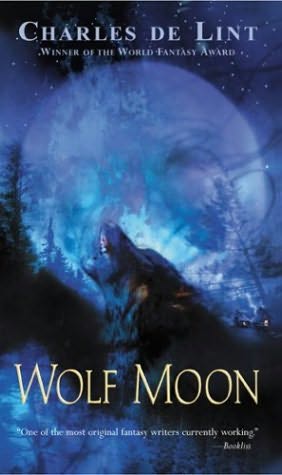
Charles De Lint. Wikipedia, 18 Oct. 2009. Web. 18 Nov. 2009.
>http://en.wikipedia.org/wiki/Charles_de_Lint<.
Charles De Lint, WolfMoon. SF Site, 2009. Web. 19 Nov. 2009.
>http://www.sfsite.com/charlesdelint/wolfmoon-desc01.htm<.
De Lint, Charles. "New Books." New Books. SF Site, 2006. Web. 19 Nov. 2009.
>http://www.sfsite.com/charlesdelint/<.
WolfMoon. Toronto, Ontario: Penguin Books, 1988. Print.
Tuesday, November 24, 2009

Monday, November 23, 2009
Apologia of Charles De Lint and his novel WolfMoon
Charles de Lint, born December 22 1951, is a Canadian fantasy author and Celtic folk musician. His work inspires anyone who is eager for an adventure. He has been writing for 20+ years, and continues to do so. Charles does not stop, he continues with his passions, sharing them with the world. Even in this year of 2009 he has released at least 6 books titled: Muse and Reverie, Eyes like Leaves, Medicine Road, The Mystery of Grace, The Onion Girl, Woods and waters Wild. Thus, his determination is strong, and everything he churns out brings happiness. (Lint, New Books) His 1984 urban fantasy novel, Moonheart, is Tor's best-selling trade paperback for their Orb line. A message board was created and named in his honor: de Lintad, Charles de Lint, and MoonHeart which proves that his contributions are significant. That alone depicts that Charles is very successful at what he does.(Lint, Wikipedia)
The significance of his work is greatly, as he has published 60 books, which in itself makes him very successful. In addition to being the author of numerous novels and short stories, De Lint is also a poet, musician, artist, folklorist, and critic. He has taught creative writing workshops in Canada and the United States, and was writer-in-residence for 2 public libraries in Ottawa. On top of this, Charles has also written original songs; his main instruments are flute, fiddle, whistles, vocals and guitar. Some say that “He’s a classic storyteller with a tremendously broad appeal. Readers who don’t know him would, I think, be surprised at how much they would like his work. I’m hoping some of those readers turn up.” Those that are curious, such as myself, had no idea of the brilliance of this man, and now his work has made me eager to learn more. His writing style and the many books Charles has turned out, are proof that he is a wonderful asset. From his short-stories, novels and songs, they go above and beyond to paint out his contributions of Canadian literature. (Lint, Review)
When looking at his famous novel WolfMoon, Charles said that: "Wolf Moon is an old favorite of mine. I remember at the time I started to work on it that I wanted to write a small story in a high fantasy setting. Worlds didn't need to be saved. The characters weren't required to go on arduous quests. But the events of the story would still have great import upon the characters because that's the way of the world. The large events that move and shake nations certainly interest us and impact upon our lives, but for most of us, the bigger stories revolve around ourselves and our circle of friends and family. I didn't see why it should be any different for the characters in a high fantasy secondary world. "(WolfMoon, Review) He brings forth a realm in which not many venture into. The Fantasy world. His "Wolf Moon is one of the rarest of Charles de Lint's novels, first published over a decade ago as a paperback, and out of print since. We're proud to be publishing the first hardcover edition of this rare fantasy, bound in full-cloth, with a full-color wraparound dust jacket."(WolfMoon, Review) Furthermore his story is magical because ”In Wolf Moon, one of de Lint's earlier novels and a rare excursion for him into high fantasy, the harper Tuiloch is the black-hearted evil. The hero of the tale, the lonely wanderer Kern, is a werewolf.” (WolfMoon, Review) Charles is able to put a spin on anything he writes, and explores into worlds in which many do not choose to attempt. His Work, especially WolfMoon draws the essence of greatness out of the reader.
The significance of his work is greatly, as he has published 60 books, which in itself makes him very successful. In addition to being the author of numerous novels and short stories, De Lint is also a poet, musician, artist, folklorist, and critic. He has taught creative writing workshops in Canada and the United States, and was writer-in-residence for 2 public libraries in Ottawa. On top of this, Charles has also written original songs; his main instruments are flute, fiddle, whistles, vocals and guitar. Some say that “He’s a classic storyteller with a tremendously broad appeal. Readers who don’t know him would, I think, be surprised at how much they would like his work. I’m hoping some of those readers turn up.” Those that are curious, such as myself, had no idea of the brilliance of this man, and now his work has made me eager to learn more. His writing style and the many books Charles has turned out, are proof that he is a wonderful asset. From his short-stories, novels and songs, they go above and beyond to paint out his contributions of Canadian literature. (Lint, Review)
When looking at his famous novel WolfMoon, Charles said that: "Wolf Moon is an old favorite of mine. I remember at the time I started to work on it that I wanted to write a small story in a high fantasy setting. Worlds didn't need to be saved. The characters weren't required to go on arduous quests. But the events of the story would still have great import upon the characters because that's the way of the world. The large events that move and shake nations certainly interest us and impact upon our lives, but for most of us, the bigger stories revolve around ourselves and our circle of friends and family. I didn't see why it should be any different for the characters in a high fantasy secondary world. "(WolfMoon, Review) He brings forth a realm in which not many venture into. The Fantasy world. His "Wolf Moon is one of the rarest of Charles de Lint's novels, first published over a decade ago as a paperback, and out of print since. We're proud to be publishing the first hardcover edition of this rare fantasy, bound in full-cloth, with a full-color wraparound dust jacket."(WolfMoon, Review) Furthermore his story is magical because ”In Wolf Moon, one of de Lint's earlier novels and a rare excursion for him into high fantasy, the harper Tuiloch is the black-hearted evil. The hero of the tale, the lonely wanderer Kern, is a werewolf.” (WolfMoon, Review) Charles is able to put a spin on anything he writes, and explores into worlds in which many do not choose to attempt. His Work, especially WolfMoon draws the essence of greatness out of the reader.
Explication of Rivalry of Superior and Inferior in WolfMoon by Charles De Lint
Of Polti’s Thirty-Six Dramatic Situations, “Rivalry of Superior and Inferior” through the two dominant characters Tuiloch and Kern is most enthused in Charle de Lint’s WolfMoon. From the beginning, Charles’ separates these two characters apart with very distinct characteristics and abilities. Through each of the different situations it’s clearly evident that Tuiloch has the upper-hand all the time. The Reader uncovers Tuiloch’s secrets and is able to build a bridge with the Inferior Kern. The lives of these two are drastically different as one is out for himself to obtain complete control on others, whereas the other is a caring intelligent man who fights for what he believes in, love.
In the opening, these two characters are painted in the story very vividly. There is a chase that occurs with the superior sending his magical beast known as the feragh to hunt down kern. "The feragh came first, agile and supple-limbed for all its bulk, soft-stepping a path through the underbrush so that not one autumnal leaf seemed disturbed."(De Lint, 5) The vast imagery is used to portray the many scenes that take place. For the reader, it is easy to grasp what is going on when there is descriptive language such as "There was magic afoot here, the wolf knew. Powerful magic against which he had no defense. Heavy though the freight’s scent was, smothering the man, the wolf could smell the sorcery. It burned in the music. It burned in the Harper’s features, highlighting his thin straight nose, planed brow, and gaunt cheek. It burned, too, in the freight’s eyes." (De Lint, 4)Charles use of the passages is magical as it brings better understanding of these two highly diversive characters.
Even through the epic beginning, these two characters entwine again. Charles’s use of descriptive language further entices the reader to continue their adventure by making the confrontation more appealing. During a small festival these two grip eye to eye when Tuiloch says "Listen, and I will tell you the tale of Tascar, the Wuhr-wulf. Now his eyes were for Kern alone. They impaled him with their strength of will, stripped the manflesh to bare the wolf inside. I know you, they said. I remember you. Echoes of that hateful music that called forth the feragh hung in the air. The hunt is not yet done, the harper's eyes appeared to say. Then he looked away and began the tale.” (De Lint, 112) In essence, the use of his imagery further develops these two characters. As well, the details provide more proof into which one is more superior. Only through Kern’s determination and striving to defeat Tuiloch would he come out ahead.
From the establishment up until the final stages, the fate of Kern seems to be sealed. His strength has been dwindled, and his determination long gone. Only through the voice of his dear friend saying “Kern please, she said. Hear me out. I’ve come here on my own. Stram led me. I know what Tuiloch’s done to us, to you.”[205] Through the voice of this angel, he was given new strength to confront the terrorizer. His flawless plan would have to be done sooner rather than later, as each minute he spent threatened his friend’s lives. There was no time for errors, as “he came in at a run, snow spraying underfoot. He saw the bulky shape of the feragh come quick silvering toward him, trying to cut him off, but he had too great a lead. Choosing a window, he leaped at it, curling himself into a ball as he struck it. His thick shoulder hair prevented the glass from penetrating deep enough to pierce his skin. He could sense the feragh at the window.” (de Lint, 226) After Kern over-powers Tuiloch through sheer determination and passion for his loves ones “he fell back, nursing his hand, trying to concentrate on Tuiloch, on the harper’s next move. But that move never came. The blade thrust up from Tuiloch’s chest and his face was so contorted that it seemed a stranger’s.” (de Lint, 238) The rivalry between Kern and Tuiloch was unbelievable as the reader had no idea that Kern could unleash such a series of powerful blows. Through his determination, passion and confidence he had conquered all odds and defeated his greatest enemy.
In the opening, these two characters are painted in the story very vividly. There is a chase that occurs with the superior sending his magical beast known as the feragh to hunt down kern. "The feragh came first, agile and supple-limbed for all its bulk, soft-stepping a path through the underbrush so that not one autumnal leaf seemed disturbed."(De Lint, 5) The vast imagery is used to portray the many scenes that take place. For the reader, it is easy to grasp what is going on when there is descriptive language such as "There was magic afoot here, the wolf knew. Powerful magic against which he had no defense. Heavy though the freight’s scent was, smothering the man, the wolf could smell the sorcery. It burned in the music. It burned in the Harper’s features, highlighting his thin straight nose, planed brow, and gaunt cheek. It burned, too, in the freight’s eyes." (De Lint, 4)Charles use of the passages is magical as it brings better understanding of these two highly diversive characters.
Even through the epic beginning, these two characters entwine again. Charles’s use of descriptive language further entices the reader to continue their adventure by making the confrontation more appealing. During a small festival these two grip eye to eye when Tuiloch says "Listen, and I will tell you the tale of Tascar, the Wuhr-wulf. Now his eyes were for Kern alone. They impaled him with their strength of will, stripped the manflesh to bare the wolf inside. I know you, they said. I remember you. Echoes of that hateful music that called forth the feragh hung in the air. The hunt is not yet done, the harper's eyes appeared to say. Then he looked away and began the tale.” (De Lint, 112) In essence, the use of his imagery further develops these two characters. As well, the details provide more proof into which one is more superior. Only through Kern’s determination and striving to defeat Tuiloch would he come out ahead.
From the establishment up until the final stages, the fate of Kern seems to be sealed. His strength has been dwindled, and his determination long gone. Only through the voice of his dear friend saying “Kern please, she said. Hear me out. I’ve come here on my own. Stram led me. I know what Tuiloch’s done to us, to you.”[205] Through the voice of this angel, he was given new strength to confront the terrorizer. His flawless plan would have to be done sooner rather than later, as each minute he spent threatened his friend’s lives. There was no time for errors, as “he came in at a run, snow spraying underfoot. He saw the bulky shape of the feragh come quick silvering toward him, trying to cut him off, but he had too great a lead. Choosing a window, he leaped at it, curling himself into a ball as he struck it. His thick shoulder hair prevented the glass from penetrating deep enough to pierce his skin. He could sense the feragh at the window.” (de Lint, 226) After Kern over-powers Tuiloch through sheer determination and passion for his loves ones “he fell back, nursing his hand, trying to concentrate on Tuiloch, on the harper’s next move. But that move never came. The blade thrust up from Tuiloch’s chest and his face was so contorted that it seemed a stranger’s.” (de Lint, 238) The rivalry between Kern and Tuiloch was unbelievable as the reader had no idea that Kern could unleash such a series of powerful blows. Through his determination, passion and confidence he had conquered all odds and defeated his greatest enemy.
Sunday, November 22, 2009
Apologia - Process work
Charles de Lint is a Canadian fantasy author and Celtic folk musician.
The significance of his work is greatly, as he has published 60 books, which in itself makes him very successful. In addition to being the author of numerous novels and short stories, De Lint is also a poet, musician, artist, folklorist, and critic. He has taught creative writing workshops in Canada and the United States, and was writer-in-residence for 2 public libraries in Ottawa
On top of all, Charles has also written original songs; his main instruments are flute, fiddle, whistles, vocals and guitar.
A message board was created and named in his honor: de Lintad, Charles de Lint, MoonHeart which proves that his contributions are significant.
He brings forth a realm in which not many venture into. The Fantasy world.
“He’s a classic storyteller with a tremendously broad appeal. Readers who don’t know him would, I think, be surprised at how much they would like his work. I’m hoping some of those readers turn up.”
He has been writing for 20+ years, and continues to do so. Charles does not stop, he continues with his passions, sharing them with the world.
Even in this year of 2009 he has relased atleast 6 books titled: Muse and Reverie, Eyes like Leaves, Medicine Road, The Mystery of Grace, The Onion Girl, Woods and waters Wild.
"Wolf Moon is an old favorite of mine. I remember at the time I started to work on it that I wanted to write a small story in a high fantasy setting. Worlds didn't need to be saved. The characters weren't required to go on arduous quests. But the events of the story would still have great import upon the characters because that's the way of the world. The large events that move and shake nations certainly interest us and impact upon our lives, but for most of us, the bigger stories revolve around ourselves and our circle of friends and family. I didn't see why it should be any different for the characters in a high fantasy secondary world. "
"Wolf Moon is one of the rarest of Charles de Lint's novels, first published over a decade ago as a paperback, and out of print since. We're proud to be publishing the first hardcover edition of this rare fantasy, bound in full-cloth, with a full-color wraparound dustjacket."
^- proof that Charle's book and his writing style are wonderful contributions of Canadian Literature.
http://www.sfsite.com/charlesdelint/wolfmoon-desc01.htm
http://www.sfsite.com/charlesdelint/
http://en.wikipedia.org/wiki/Charles_de_Lint
The significance of his work is greatly, as he has published 60 books, which in itself makes him very successful. In addition to being the author of numerous novels and short stories, De Lint is also a poet, musician, artist, folklorist, and critic. He has taught creative writing workshops in Canada and the United States, and was writer-in-residence for 2 public libraries in Ottawa
On top of all, Charles has also written original songs; his main instruments are flute, fiddle, whistles, vocals and guitar.
A message board was created and named in his honor: de Lintad, Charles de Lint, MoonHeart which proves that his contributions are significant.
He brings forth a realm in which not many venture into. The Fantasy world.
“He’s a classic storyteller with a tremendously broad appeal. Readers who don’t know him would, I think, be surprised at how much they would like his work. I’m hoping some of those readers turn up.”
He has been writing for 20+ years, and continues to do so. Charles does not stop, he continues with his passions, sharing them with the world.
Even in this year of 2009 he has relased atleast 6 books titled: Muse and Reverie, Eyes like Leaves, Medicine Road, The Mystery of Grace, The Onion Girl, Woods and waters Wild.
"Wolf Moon is an old favorite of mine. I remember at the time I started to work on it that I wanted to write a small story in a high fantasy setting. Worlds didn't need to be saved. The characters weren't required to go on arduous quests. But the events of the story would still have great import upon the characters because that's the way of the world. The large events that move and shake nations certainly interest us and impact upon our lives, but for most of us, the bigger stories revolve around ourselves and our circle of friends and family. I didn't see why it should be any different for the characters in a high fantasy secondary world. "
"Wolf Moon is one of the rarest of Charles de Lint's novels, first published over a decade ago as a paperback, and out of print since. We're proud to be publishing the first hardcover edition of this rare fantasy, bound in full-cloth, with a full-color wraparound dustjacket."
^- proof that Charle's book and his writing style are wonderful contributions of Canadian Literature.
http://www.sfsite.com/charlesdelint/wolfmoon-desc01.htm
http://www.sfsite.com/charlesdelint/
http://en.wikipedia.org/wiki/Charles_de_Lint
Explication of Rivalry of superior and inferior in WolfMoon by Charles De Lint - Process work
Description
Elements
* The Superior Rival
* The Inferior Rival
* The Object of Rivalry
Summary
The Superior Rival is set against an Inferior Rival, both vying for the Object of Rivalry.
Variants
A
1. Rivalry of a mortal and an immortal
2. Rivalry of two divinities of unequal power
3. Rivalry of a magician and an ordinary man
4. Rivalry of conqueror and conquered
5. Rivalry of victor and vanquished
6. Rivalry of a master and a banished man
7. Rivalry of suzerain king and vassal king
8. Rivalry of a king and a noble
9. Rivalry of a powerful person and an upstart
10. Rivalry of rich and poor
11. Rivalry of an honored man and a suspected one
12. Rivalry of two who are almost equal
13. Rivalry of equals, one of whom has in the past been guilty of adultery
14. Rivalry of a man who is loved and one who has not the right to love
The key variants to match the story are 1,2,3,6,9 and 14 -
The story WolfMoon revolves mainly around the life of Kern who is human, but posseses a trait to turn into a werewolf whenever he wants.
Tuiloch(magician) is the Superior Rival, whereas Kern(human-werewolf) is the inferior Rival.
The clash between these two occur from the early stages of the book, right until the final stage.
"The feragh came first, agile and supple-limbed for all its bulk, soft-stepping a path through the underbrush so that not one autumnal leaf seemed disturbed."[Wolfmoon, 5]
- the feragh represents a powerful beast in while Tuiloch(the Superior Rival) unleashes on Kern(the Inferior Rival)
"There was magic afoot here, the wolf knew. Powerful magic against which he had no dfense. Heavy though the feragh's scent was, smothering the man, the wolf could smell the sorcery. It burned in the music. It burned in the harper's features. highlighting his thin straight nose, planed brow, and gaunt cheek. It burnedd, too, in the feragh's eyes." [WolfMoon, 4]
- proof that Tuiloch (superior rival) which is also noted as the harper is a very powerful sorceror. Not only does Kern(inferior rival) feel his powers, but so does the beast in which Tuiloch unleashes (feragh.
"He was no longer sure how long or how far the hunt had gone. The harping dulled his senses, weakened his limbs, and he could not find the strength to overcome it. He needed to strike out at his tormentor, to still the hateful music forever, but to reach the harper he must first face the feragh and in that acton lay only death. He was unwilling to throw away his life. First the harper must be made to pay. That need sustained him more than simple survival."[WolfMoon, 5]
“The feragh was hellishly close. Its reek clogged the wolf’s nostrils. The music fired his mind with scalding flames, numbing him.” [WolfMoon, 5]
- Tuiloch's powers affect Kern greatly, and there is nothing he can do to defend himself. Not only does kern need to have the strength to defeat the powerful sorceror, but he faces the beast in which Tuiloch unleashed. His fate is sealed when dealing with either of them as they are too much of a match.
These two rivals are on completely different spectrums. Tuiloch is a powerful Sorceror that has great influence with his magic and the ability to unleash a foul creature, whereas Kern is only a man with the ability to change into a strong Werewolf.
After the beginning, Kern barely escapes his fate. “Then he saw something red bobbing downstream, watched it strike a boulder before the current dragged it under once more.”
Description of Kern's wound: "His left shoulder was gashed as though some wild animal had clawed him and he was streaked with mud"
The two Rivals set apart from then, and only meet up about at the halfway mark.
"Listen, and I will tell you the tale of Tascar, the Wuhr-wulf. Now his eyes were for Kern alone. They impaled him with their strength of will, stripped the manflesh to bare the wolf inside. I know you, they said. I remember you. Echoes of that hateful music that called forth the feragh hung in the air. The hunt is not yet done, the harper's eyes appeared to say. Then he looked away and began the tale.[WolfMoon, 112]
"A last time he looked at Kern, his dark eyes promising terrors to come, and he smiled."[WolfMoon, 112]
- The lines prove that Tuiloch is an unmatched Rival. He pierces Kern with such powers to "strip the manflesh", only through determination could Kern stand toe-to-toe which such a Magician.
“Kern please, she said. Hear me out. I’ve come here on my own. Stram led me. I know what Tuiloch’s done to us, to you.”[205]
“he came in at a run, snow spraying underfoot. He saw the bulky shape of the feragh come quicksilvering toward him, trying to cut him off, but he had too great a lead. Choosing a window, he leaped at it, curling himself into a ball as he struck it. His thick shoulder hair prevented the glass from penetrating deep enough to pierce his skin. He could sense the feragh at the window.” [226]
“he fell back, nursing his hand, trying to concentrate on Tuiloch, on the harper’s next move. But that move never came. The blade thrust up from Tuiloch’s chest and his face was so contorted that it seemed a stranger’s.
- Through the end passages, Kern summons the strength to return to the inn by Fion, he is the only hope, and it will be through his sacrifice that lives would be spared if he can defeat Tuiloch. He has lost all sense of fear, and is willing to sacrifice his life for the survival of those that are taken hostage by Tuiloch. A man reborn, Kern becomes as he is unopposed by the feragh, and with the aid of Fion, defeats the Superior Rival. A match through determination and willingness to sacrifice himself proclaimed Kern the victor.
Elements
* The Superior Rival
* The Inferior Rival
* The Object of Rivalry
Summary
The Superior Rival is set against an Inferior Rival, both vying for the Object of Rivalry.
Variants
A
1. Rivalry of a mortal and an immortal
2. Rivalry of two divinities of unequal power
3. Rivalry of a magician and an ordinary man
4. Rivalry of conqueror and conquered
5. Rivalry of victor and vanquished
6. Rivalry of a master and a banished man
7. Rivalry of suzerain king and vassal king
8. Rivalry of a king and a noble
9. Rivalry of a powerful person and an upstart
10. Rivalry of rich and poor
11. Rivalry of an honored man and a suspected one
12. Rivalry of two who are almost equal
13. Rivalry of equals, one of whom has in the past been guilty of adultery
14. Rivalry of a man who is loved and one who has not the right to love
The key variants to match the story are 1,2,3,6,9 and 14 -
The story WolfMoon revolves mainly around the life of Kern who is human, but posseses a trait to turn into a werewolf whenever he wants.
Tuiloch(magician) is the Superior Rival, whereas Kern(human-werewolf) is the inferior Rival.
The clash between these two occur from the early stages of the book, right until the final stage.
"The feragh came first, agile and supple-limbed for all its bulk, soft-stepping a path through the underbrush so that not one autumnal leaf seemed disturbed."[Wolfmoon, 5]
- the feragh represents a powerful beast in while Tuiloch(the Superior Rival) unleashes on Kern(the Inferior Rival)
"There was magic afoot here, the wolf knew. Powerful magic against which he had no dfense. Heavy though the feragh's scent was, smothering the man, the wolf could smell the sorcery. It burned in the music. It burned in the harper's features. highlighting his thin straight nose, planed brow, and gaunt cheek. It burnedd, too, in the feragh's eyes." [WolfMoon, 4]
- proof that Tuiloch (superior rival) which is also noted as the harper is a very powerful sorceror. Not only does Kern(inferior rival) feel his powers, but so does the beast in which Tuiloch unleashes (feragh.
"He was no longer sure how long or how far the hunt had gone. The harping dulled his senses, weakened his limbs, and he could not find the strength to overcome it. He needed to strike out at his tormentor, to still the hateful music forever, but to reach the harper he must first face the feragh and in that acton lay only death. He was unwilling to throw away his life. First the harper must be made to pay. That need sustained him more than simple survival."[WolfMoon, 5]
“The feragh was hellishly close. Its reek clogged the wolf’s nostrils. The music fired his mind with scalding flames, numbing him.” [WolfMoon, 5]
- Tuiloch's powers affect Kern greatly, and there is nothing he can do to defend himself. Not only does kern need to have the strength to defeat the powerful sorceror, but he faces the beast in which Tuiloch unleashed. His fate is sealed when dealing with either of them as they are too much of a match.
These two rivals are on completely different spectrums. Tuiloch is a powerful Sorceror that has great influence with his magic and the ability to unleash a foul creature, whereas Kern is only a man with the ability to change into a strong Werewolf.
After the beginning, Kern barely escapes his fate. “Then he saw something red bobbing downstream, watched it strike a boulder before the current dragged it under once more.”
Description of Kern's wound: "His left shoulder was gashed as though some wild animal had clawed him and he was streaked with mud"
The two Rivals set apart from then, and only meet up about at the halfway mark.
"Listen, and I will tell you the tale of Tascar, the Wuhr-wulf. Now his eyes were for Kern alone. They impaled him with their strength of will, stripped the manflesh to bare the wolf inside. I know you, they said. I remember you. Echoes of that hateful music that called forth the feragh hung in the air. The hunt is not yet done, the harper's eyes appeared to say. Then he looked away and began the tale.[WolfMoon, 112]
"A last time he looked at Kern, his dark eyes promising terrors to come, and he smiled."[WolfMoon, 112]
- The lines prove that Tuiloch is an unmatched Rival. He pierces Kern with such powers to "strip the manflesh", only through determination could Kern stand toe-to-toe which such a Magician.
“Kern please, she said. Hear me out. I’ve come here on my own. Stram led me. I know what Tuiloch’s done to us, to you.”[205]
“he came in at a run, snow spraying underfoot. He saw the bulky shape of the feragh come quicksilvering toward him, trying to cut him off, but he had too great a lead. Choosing a window, he leaped at it, curling himself into a ball as he struck it. His thick shoulder hair prevented the glass from penetrating deep enough to pierce his skin. He could sense the feragh at the window.” [226]
“he fell back, nursing his hand, trying to concentrate on Tuiloch, on the harper’s next move. But that move never came. The blade thrust up from Tuiloch’s chest and his face was so contorted that it seemed a stranger’s.
- Through the end passages, Kern summons the strength to return to the inn by Fion, he is the only hope, and it will be through his sacrifice that lives would be spared if he can defeat Tuiloch. He has lost all sense of fear, and is willing to sacrifice his life for the survival of those that are taken hostage by Tuiloch. A man reborn, Kern becomes as he is unopposed by the feragh, and with the aid of Fion, defeats the Superior Rival. A match through determination and willingness to sacrifice himself proclaimed Kern the victor.
Thursday, November 19, 2009
Quick Look
Wolf Moon is not too challenging a read, Rob, so I should see some evidence of the explication and apologia by now. Toss what you have so far into a post just to exhibit your process.
Saturday, November 7, 2009
Links & Welcome
There is no Links List or Welcome post, Rob. How come? With the due date looming, you can't afford to get behind on the research necessary to complete the work! Get moving fast!
Sunday, October 4, 2009
Reading Response #4
Upon reading into the last chapters of WolfMoon by Charles De Lint, I started to become more awake as too what was going on. Kern faces his greatest fear, as he has been set-up by the harper. “There was a smell in the air, familiar, sharp, and acrid. And then his eyes adjusted to the glare and he need ask his question no more. He saw what was left of Tolly. The boy had been ravaged by some beast. Half his face was gone. Blood soaked his nightshirt and splattered the snow, dark and red against the white.” [154-155] The harper struck first, and turned all of Kern’s friends against him. Luckily before being killed in front of everyone, kern mustered up the strength to escape. “One moment he crouched, muscles bunched to spring, the next he was off, around the barn, the crisp snow under his paws, the shirt flapping about him. He took the time to roll against a bush and tear it from him before running on, unencumbered. And unpursued. From then on, after Kern had left, his followers would feel the harper’s wrath. The inn-keepers now had no protection against such a person who terrorized them into thinking Kern was guilty. Through the chapters, Charles goes into detail about the harpers actions. “He directed Tomtim and Wat to the window to nail up boards to shut out the storm. You draw the wolf, he said to Ainsy.” The inn-keepers were under the harpers control, except for the one individual who stood out, Fion. She was the only one who was not affected by the harper and his advances. Charles takes WolfMoon to the point where Fion sneaks out to consult Kern and tell him how she feels. “Kern please, she said. Hear me out. I’ve come here on my own. Stram led me. I know what Tuiloch’s done to us, to you.”[205] Together as a team, did Kern have the strength to confront the harper, but such a thing would not be easy, they needed a solid plan. As I continued reading, every page was full of intense imagery and details. I thought to myself, what if Kern fails? What will happen to all of the innocent people then? Charles’ paints the scene where Kern finally makes his appearance, to face the harper. “he came in at a run, snow spraying underfoot. He saw the bulky shape of the feragh come quicksilvering toward him, trying to cut him off, but he had too great a lead. Choosing a window, he leaped at it, curling himself into a ball as he struck it. His thick shoulder hair prevented the glass from penetrating deep enough to pierce his skin. He could sense the feragh at the window.” [226] The imagery Charles creates continues as Kern defeats the harper, with Fions help. “he fell back, nursing his hand, trying to concentrate on Tuiloch, on the harper’s next move. But that move never came. The blade thrust up from Tuiloch’s chest and his face was so contorted that it seemed a stranger’s. WolfMoon, through the writing of Charles De Lint brings something special out in all readers. The archetypal pattern he illustrates is very notable, but with a series of conflicts resulting in the Hero facing his worst fear, to protect those that he loves.
Reading Response #3
After the rescue of Ainsy’s uncle (Tomtin) everything begins to go back to normal. However, the author does not let this continue. Instead of making the story full of happiness like most readers enjoy, Charles throws another curveball. A gathering occurs in a town a fair bit off, but the center of attention is Kern’s enemy, a harper. He seizes the opportunity to go with the inn-dwellers to this magical event. He seeks to get even by destroying the harper, thus bringing peace to the land again. At first the author gives the reader with the allusion that the harper does not recognize Kern. “He passed over Kern without a flicker of recognition. He saw me only in wolfshape, Kern thought. Why should he recognize me now as a man? Perhaps i’m still safe and the secret’s mine alone.”[110] The harper continued throughout the evening, until he started to tell a tale. “Listen, and I will tell you the tale of Tascar, the Wehr-wulf. Now his eyes were for Kern alone. They impaled him with their strength of will, stripped the manflesh to bare the wolf inside.”[112] Through these lines I found that this “harper” was a very magical foe. It would only be through determination and strength that Kern could stand up against such a thing. The author indicates that Kern must make a decision. He must rise to face the harper before time is out, or there could be a much different fate. “But as he stabled the horse and made his way into the inn, another concern rose in him. What if the harper struck at him through Ainsy or one of the others? He’d kept that fear at the back of his mind, but standing in the courtyard, feeling the close warmth of the inn and its occupants all around him, it surfaced stronger than ever. Must he go? Could he risk their lives by staying? [118] As said, this is one of the inner pressures Kern faces. He almost can see the future, but has no idea how to stop the onslaught. However, before Kern can make his move, the conflict is brought to his inn. His thought we’re correct that the harper would strike at him through his Ainsy. The harper uses his charm and persuasiveness to control Ainsy . “When I first saw you at the foxfire, I knew I must know you better.”[136] Kern’s inner struggle would continue, and it would only be when the harper was vanquished that his love would return. He words meant nothing, as long as the harper was around. Charles continues the story with tensions growing deeper between Kern and the harper, only one would win in the end. The conflict arising between these two very magical characters prompted me to continue painting the imagery.
Reading Response #2
The next part of WolfMoon mainly deals with Kern, his life and challenges at the inn and his charm toward a girl at the inn. Charles’ technique to make the reader believe they are a part of the story is fantastic. He makes the reader have the urge to put the details together and create the picture. His descriptive imagery is present when Kern is walking beside his new friend, Ainsy. “They walked side by side, not touching, but Ainsy’s scent filled his nostrils with the heady perfume that was uniquely hers and, close as she was, he could almost feel her body heat like fire on his skin.” [66] The affection between these characters grows more, and Kern feels that this girl has won his affection without effort. Kern feeling very close to this girl promises that he would never see her hurt. These are very magical words between lovers, and even at an early stage to their affection for one another, he knows his heart is only for her. Everything continues for the next while lovely as the two progress closer to each other. To not lead the reader away, Charles then throws in that a mysterious man arrives at the inn, and reveals information about Ainsy’s lost uncle. “I saw a wagon just like you’ve described in the pass this evening. It was late and getting on dark, when I saw it sitting a ways off the road under some pines. I gave it a hail, but there was no answer and I didn’t have time to go have a look-see.”[75] The story’s theme then moves into another conflict and rescue, as Kern the main character, goes to find out the situation on Ainsy’s uncle. Upon arrival, Kern is faced with a painful decision. Charles’ Style turned Kern into a hero, but not the usual type. He turned Kern into something between that of two worlds. “He rose to his feet and willed the change, stopping it partway. Red fur covered his body, but he remained upright. His neck sank low against his chest. His face lengthened, mannish teeth becoming wolfish fangs. His legs were bowed somewhat, but the thrust of a half-grown tail from the posterior balanced him. He rumbled a threatening growl low in his chest and loosed it through lips that were neither man’s nor beast’s. The sound rose up from his diaphragm, low and resonating, inhuman.”[85] By reading through the imagery, I could paint the picture of this man changing into something unrealistic. Charles’ use of descriptive words fall hand-in-hand with his plot, as he creates the hero in the form of a beast. The story folds into some beautiful and tragic, as Kern faces new conflicts, and inner pressures.
Reading Response #1
The first sentence in WolfMoon by Charles De Lint, brought an eerie feeling. Starting with “The music stopped” [1] it already had me involved and eager to continue. Immense details about a “wolf” paint out all of his very actions, his feelings, senses and even the atmosphere around him to the reader. Continuing onto the 2nd and 3rd page, I realised that this “wolf” was being stalked by a powerful and menacing beast. The “stalk” brought me closer into the story, and eager to read what would take place. The style of Charles De Lint is fantastic, as even in the first 3 pages there is an eerie starting line, a conflict with a beast stalking another, and immense details about everything going on. From the 5th page the confrontation between the beasts is nearing. “The feragh was hellishly close. Its reek clogged the wolf’s nostrils. The music fired his mind with scalding flames, numbing him.” [5] These two sentences bring vast imagery as the actions and the scalding flames are painted into the readers mind. With further reading into the 6th and 7th pages the confrontation occurs and wounds are inflicted upon the innocent wolf. The author throws the line “With the last of his strength, before the creature could strike its final blow, he heaved himself over the cliff to plummet to the waters far below. [6] Immediately after reading this I wanted to know what happened to the wolf, whether or not if he survived the fall. The next line on Page 7 brings an eerie feeling of imagery itself “Then he saw something red bobbing downstream, watched it strike a boulder before the current dragged it under once more.”[7] Thus already in the first 8 pages, there is a conflict, there is also a vast amount of imagery and it pinned me to the book. The second chapter introduces more characters and them finding a man who had washed up. As I read I connected that the man must have been the wolf as he was hurt in the same areas described from the attack. “His left shoulder was gashed as though some wild animal had clawed him and he was streaked with mud “. [18] A wolf that can change into a man must have some very unique characteristics i thought as i continued reading. He was brought to an inn, and was healed generously by the inn-keepers. It wasn’t until the 3rd Chapter that I uncovered what the Man’s name was, Kern. The author did not reveal his name until the reader was engrossed into the story. So as a recap, the first 60 pages included: a conflict, confrontation, vast imagery, rescue, introduction of many characters good and evil, and the style of Charles De Lint’s writing.
Subscribe to:
Posts (Atom)